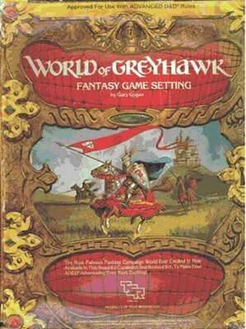
Greyhawk: A Look at Veluna

Veluna is a good-aligned theocracy in the World of Greyhawk, and the setting of my current Greyhawk campaign. It wasn’t originally, but it’s where the adventurers have ended up. As a result, it behoves me to have a look at the country, and see what adventures it inspires. I use two main sources for information on Veluna: the 1983 World of Greyhawk boxed set and … Continue reading Greyhawk: A Look at Veluna

Hit Points Through the Editions, part 3

Dungeons & Dragons, 3rd Edition was a major change to how Dungeons & Dragons worked. Over the years, AD&D 2E had become a sprawling beast that had a lot of very good ideas, but no unifying mechanics. Every supplement presented new ways of doing things and the resulting system had turned into rather a mess. So, 3E (which dropped the “Advanced”, though being the direct … Continue reading Hit Points Through the Editions, part 3

When Concentration Fails

One of the more fascinating mechanics of the 5th edition of Dungeons & Dragons is the concentration mechanic. For those not familiar with the mechanic, it creates a limitation on how many spell effects can be used at once. Each caster may only concentrate on one spell with a duration of concentration; thus, there is no way that a caster could maintain both a fly … Continue reading When Concentration Fails

Designing Dungeons: Empty Rooms

When you design a dungeon, do you put in rooms with no monsters or traps? I do. Apart from anything else, they provide space that prevent every monster in the dungeon learning that there are adventurers present and converging on them for one mass battle. That’s amusing. But only once. However, an empty room shouldn’t be entirely empty. Each “empty” room is the opportunity to … Continue reading Designing Dungeons: Empty Rooms

Thoughts on Campaign Structure

It’s Friday night, and I’m at home not playing an RPG. This feels odd. The reason I’m not playing an RPG is that the hosts of our Friday Night RPG sessions, Martin and Peggy, have wandered off to another part of Australia. Typically, we alternate weeks between two RPGs. I DM my 5E D&D Greyhawk game one week, and Martin DM’s another RPG the other … Continue reading Thoughts on Campaign Structure

An Encounter in the Savage Jungle

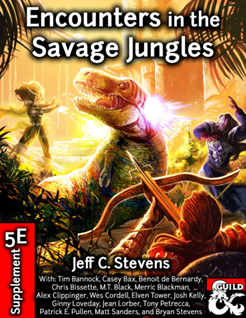
The latest adventure compilation by Jeff C. Stevens, Encounters in the Savage Jungles, is now available on the DMs Guild. It’s a collection of short adventures and encounters to use in any jungle-based campaign, such as Tomb of Annihilation. It’s not D&D Adventurers League legal, but that shouldn’t bother most of you. It’s also a product I can’t review. Why? Because I contributed to the … Continue reading An Encounter in the Savage Jungle

Examining a Subclass: Path of the Courageous Heart

I’m fascinated by the new subclasses in Xanathar’s Lost Notes to Everything Else. In fact, most new class designs fascinate me, although actually evaluating them? It’s hard. You need to playtest them. As it happens, the element of D&D that will see more play than anything else after the basic systems are the character classes. An individual spell that goes wrong can be easily excluded. … Continue reading Examining a Subclass: Path of the Courageous Heart

Xanathar’s Lost Notes to Everything Else – A First Look at the Subclasses

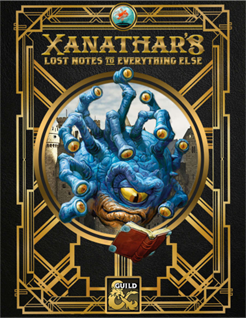
One of the interesting innovations of the DMs Guild and Wizards of the Coast this year has been to elevate the work of a group of skilled designers. Titled the “Guild Adepts”, these designers have had early access to upcoming D&D products, and have crafted supplementary products. The latest of these releases is Xanathar’s Lost Notes to Everything Else, an 87-page pdf that covers a … Continue reading Xanathar’s Lost Notes to Everything Else – A First Look at the Subclasses

The Joy and Frustrations of Investigations

I’m currently writing a Convention-Created-Content adventure for premiere next year. It also happens to be an investigation. Yes, two things I’d never thought I’d do. Investigations are tremendously popular as D&D Adventurers League scenarios, but they’re very different to the D&D scenarios I grew up with. Those scenarios involved some wilderness travel and a lot of fighting monsters in a dungeon, perhaps with some interesting … Continue reading The Joy and Frustrations of Investigations

Decisions and Consequences

Why do you put a puzzle in a game of Dungeons & Dragons? The answer: To challenge the players. I feel it is a great mistake to believe that it’s there to challenge the characters. They’re imaginary. They’re not playing the game. It’s the players sitting around the table with you who the puzzle is for. And, if your players don’t like puzzles, it’ll be … Continue reading Decisions and Consequences